
International solidarity
Dear Friends,
Welcome to our August newsletter!
We begin this month with a report on a significant meeting in Washington DC on Church-labor issues chaired by former International YCW chaplain, Bishop Reginaldo Andrietta, who also worked in Baltimore MD to extend the movement in the US.
Writing on behalf of Pope Leo, Cardinal Pietro Parolin warns that humanity is at a crossroads with AI.
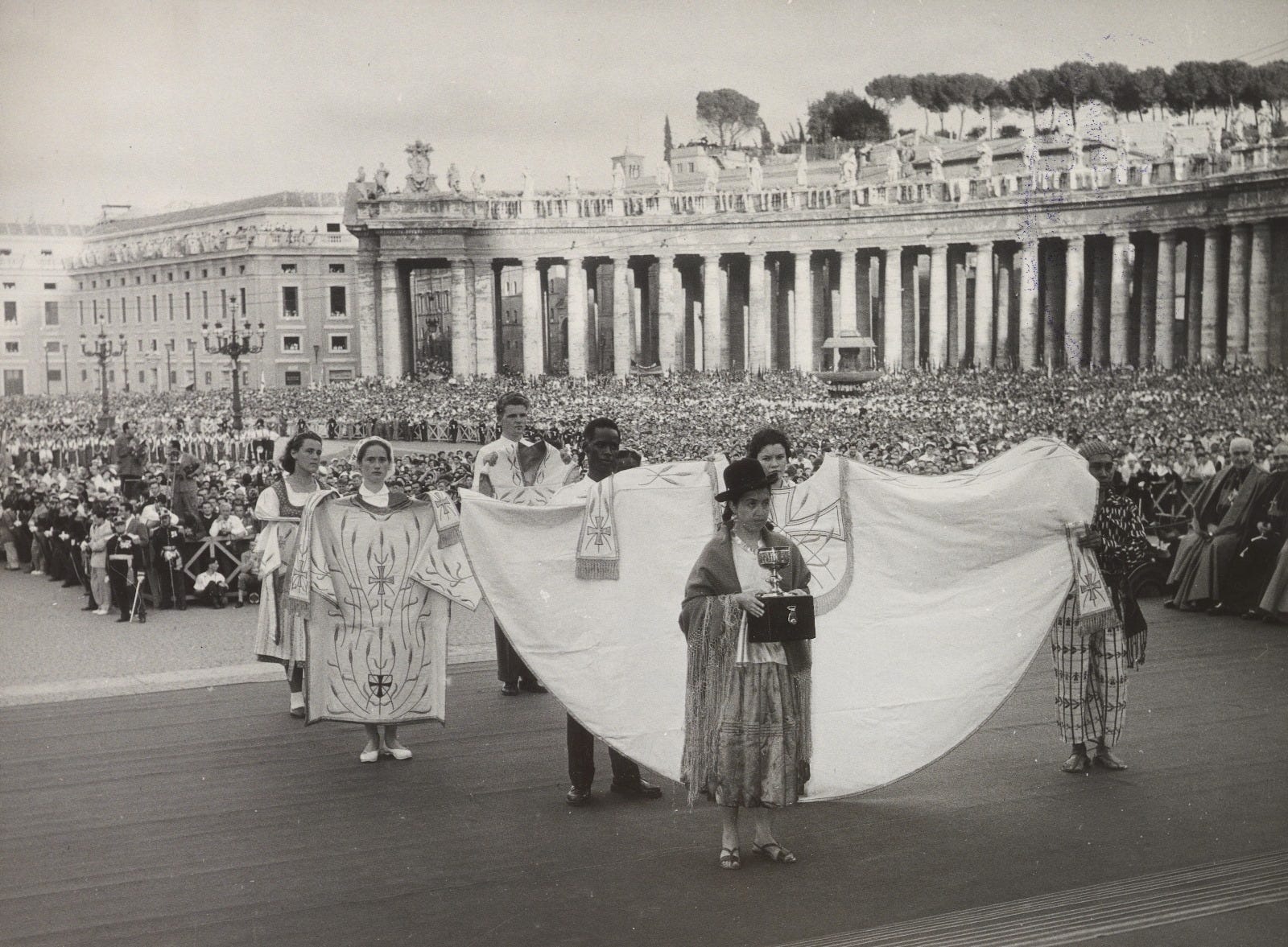
The International YCW recalls a famous pilgrimage to Rome in 1957 (photo above) that marked the foundation of the movement. Meanwhile the Australian Cardijn Institute’s September webinar will focus on the French JOC martyr, Marcel Callo.
American National Catholic Reporter writer, Michael Sean Winters, asks whether it's time for a revival of "Catholic Action," or as Cardijn may have preferred to express it, a revival of the lay apostolate of lay people.
Brazil’s Fraternity Campaign is celebrating the 60th anniversary of its see judge act community organising program.
Australian Fr Bruce Duncan CSsR continues his analysis of Pope Francis' legacy on economic issues. Speaking of economics, we have the video of our webinar with Dallas Catholic Social Teaching specialist, John Médaille, looking at the threat of economic collapse and the potential for a Catholic-inspired response.
As usual, Pat Branson and Richard Pütz have their own Cardijn-inspired reflections.
Thanks for being with us!
The Centre International Cardijn Team
Historic meeting strengthens cooperation between labour and Church
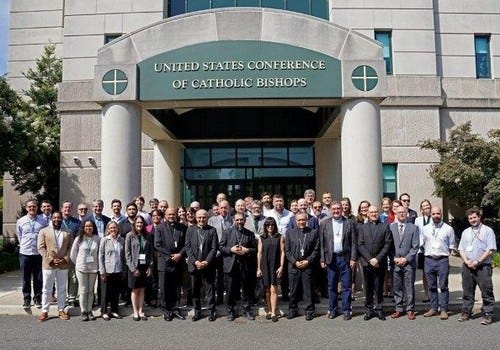
A historic meeting advanced the cooperation agenda between organized labour groups and ecclesial networks on dignified work and care for our common home at the Third Synodal Meeting Fratelli Tutti: North-South Socio-Environmental Dialogue at the headquarters of the United States Conference of Catholic Bishops (USCCB) in Washington, DC on July 28 and 29.
The meeting was led by former International YCW chaplain and YCW extension in Baltimore, MD, Bishop of Jales (Brazil) Reginaldo Andrietta representing the South, Bishop of Brownsville (United States) Daniel Flores representing the North, and Nuncio Juan Antonio Cruz, Permanent Observer of the Holy See to the Organization of American States.
The meeting served to "exchange diverse perspectives among different social actors in the world of organized labor," according to Peruvian Ana Facho Ortiz of the Young Christian Workers of America.
READ MORE
Synodal meeting in US strengthens cooperation between labor groups and Church (Vatican News)
Humanity at crossroads with AI: Vatican

“Humanity is at a crossroads, facing the immense potential generated by the digital revolution driven by Artificial Intelligence,” Vatican Secretary of State Cardinal Pietro Parolin wrote in a message to the United Nations Summit on AI.
“The impact of this revolution is far-reaching, transforming areas such as education, work, art, healthcare, governance, the military, and communication. This epochal transformation requires responsibility and discernment to ensure that AI is developed and utilized for the common good, building bridges of dialogue and fostering fraternity, and ensuring it serves the interests of humanity as a whole.
“While AI can simulate aspects of human reasoning and perform specific tasks with incredible speed and efficiency, it cannot replicate moral discernment or the ability to form genuine relationships. Therefore, the development of such technological advancements must go hand in hand with respect for human and social values, the capacity to judge with a clear conscience, and growth in human responsibility.”
READ MORE
Message on behalf of Pope Leo for AI for Good Summit (Vatican)
Prospective: Reviving Catholic Action?
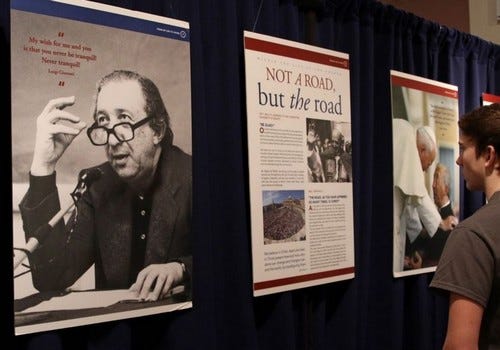
In 2015, American priest, Fr Bruce Nieli issued "a call to retrieve and renew Catholic Action in our time and examine some of the theoretical issues that could help achieve a revival," writes Michael Sean Winters in a three-part series in the US National Catholic Reporter.
"As Nieli notes, the movement started in the late 19th century to combat rampant anti-clericalism, but in the 20th century, it took on a different trajectory. Catholic Action became the effort of Catholic laity, working with the hierarchy and local clergy, to bring Catholic social teaching into the public square. It involved everything from community organizing along the lines of the Back of the Yards Council in Chicago to the Legion of Mary to Cursillo and to the Young Trade Unionists.
"Catholic Action, as Nieli wrote, laid some of the groundwork for the emphasis on the role of the laity that emerged at the 1962-65 Second Vatican Council, but there has been "a subsequent lull" since then.
"This is counterintuitive. If the council called for increased lay participation, why did Catholic Action not grow?
READ MORE
Looking for better ways to evangelize than posting on social media (National Catholic Reporter)
To revive the Catholic Action movement, don't leave dogma at the door (National Catholic Reporter)
Where to start in reviving Catholic Action (National Catholic Reporter)
Retrospective: The legacy of Pope Francis Part II: Signs of hope
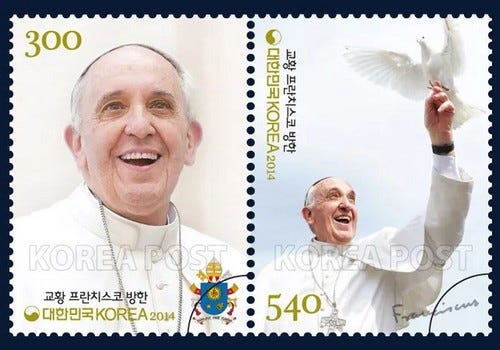
In an address to the president of the UN General Assembly and finance ministers of various nations on 27 May 2019, Pope Francis again warned that the world was heading “towards disaster” from greenhouse gases, writes Fr. Bruce Duncan CSsR in the second instalment of his reflection on the legacy of the late pontiff.
He blamed “the idolatry of money, along with the corruption of vested interests. We still reckon as profit what threatens our very survival”. On 9 June, he again lamented the slow progress to achieve the SDGs. A few days later, on 14 June, he appealed to executives from leading energy companies to help avert “a climate emergency”, and said carbon pricing was “essential”.
READ MORE
The legacy of Pope Francis in an unjust world: Part 2 (Cardijn Reflections)
Brazil’s Fraternity Campaign: 60 years of see judge act
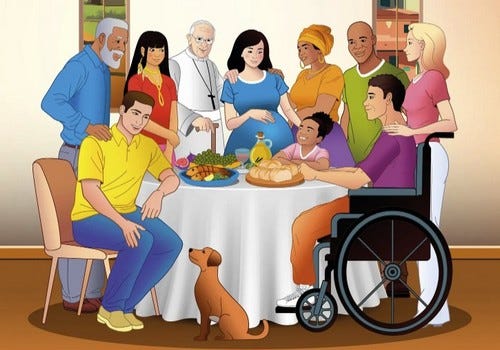
This new article by João Akio Ribeiro Yamaguchi charts the historical evolution of Brazil’s Fraternity Campaign (1961–2025) through qualitative content analysis of official texts, posters, and hymns, supplemented by census data and synodal documents.
It argues that the campaign’s enduring see-judge-act framework has allowed the Brazilian Catholic Church to recalibrate its public engagement across three major inflexions: social charity under dictatorship, rights-based citizenship after redemocratisation, and integral ecology in the Francis pontificate.
READ MORE
Brazil’s Fraternity Campaign (See Judge Act)
Rome 1957: A large international gathering
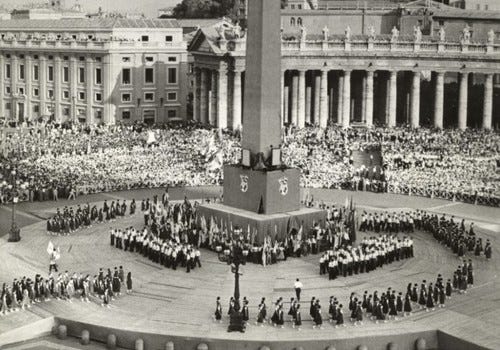
The year 1957 was when I discovered the YCW in school at the age of 14, writes Marlyse Thommen. Jeanine, a friend who was already an activist in a grassroots group, asked me to help her fill out an enquiry that the movement was conducting nationwide on wages and money. It was my first invitation to observe and form an opinion: SEE, JUDGE...
Shortly afterwards, she told me that the movement was organizing a large international gathering that year with delegates from every country: it was ROME 57!
To help fund the delegates' trip, we had to come up with activities that would raise money: for example, collecting aluminum bottle caps, gathering them so we could sell them in bulk instead of throwing them away. It never would have covered a train ticket to Rome, but we collected and collected... and proudly made our small contribution.
READ MORE
Rome 1957: A large international gathering
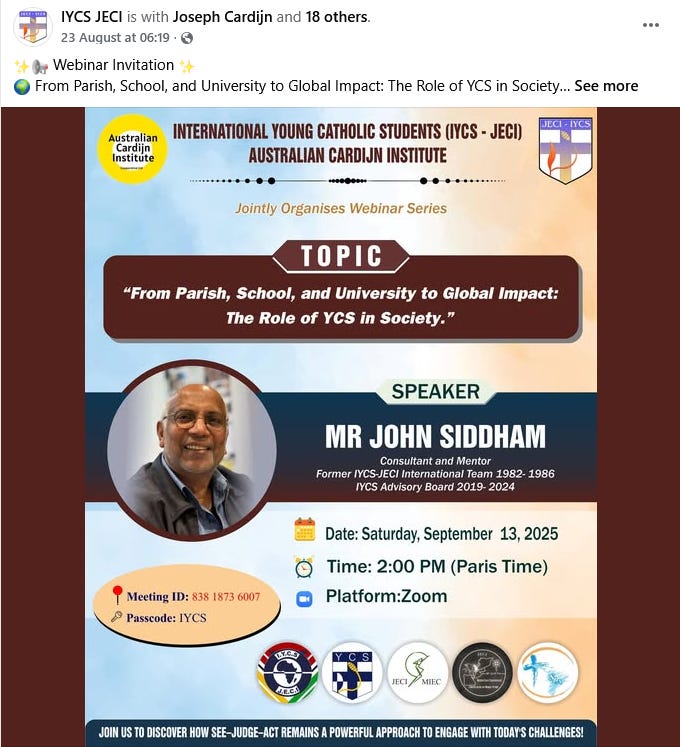
Webinar: Blessed Marcel Callo, YCW martyr
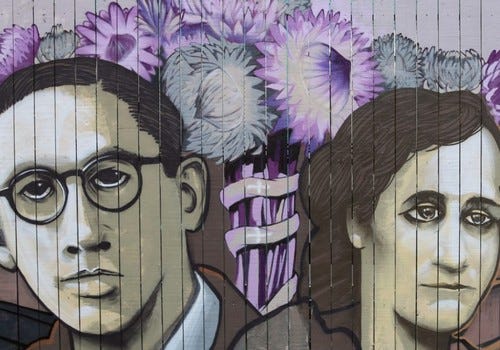
Thomas Gueydier, postulator for the cause for canonisation of French YCW martyr Blessed Marcel Callo and author of a new book on the subject, will address a webinar organised by the Australian Cardijn Institute at 11am CET on Tuesday 9 September 2025.
As well as being the centenary of the foundation of the YCW, this year also marks the 80th anniversary of Marcel’s death as well as being the 80th anniversary of YCW lay co-founders, Fernand Tonnet and Paul Garcet.
Webinar details
Tuesday 9 September 2025
7pm Australian Eastern Time, 11am Central European (Paris-Brussels) Time.
Register here
https://us02web.zoom.us/meeting/register/XsGGBXJASrSk3KKcZCphSA
Gospel: About mercy and forgiveness
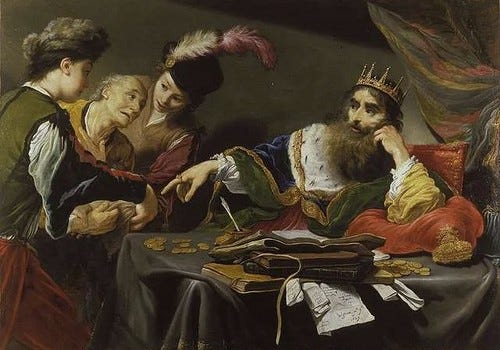
Did Fr Joseph Cardijn develop the See, Judge, Act method for use by individuals? asks Pat Branson. In a 1951 article Cardijn wrote,, he emphasised “the necessity of setting the apostolic life of laypeople in a communal frame-work, illumined by a communal vision.”
The “communal frame-work” to which he refers is characterised by “aspirations and testimonies of Christian charity, poverty, detachment, purity—in short, a fully Christian life according to the Gospels”. The See, Judge, Act method was Cardijn’s way of forming and maintaining the “communal frame-work.” Further in his article, he makes the point that Christian formation is not an individual thing. We need others in order to be saved.
By far the largest group in the Church is made up of laypeople. Cardijn asserted that “laypeople form themselves amongst themselves through brotherly contact with one another and an interaction which permits all individual qualities and responsibilities to be brought into play.”
So, what does this mean for users of this and other Gospel Enquiries?
READ MORE
About mercy and forgiveness (Cardijn Reflections)
Reflection: Are you part of praxis wing?
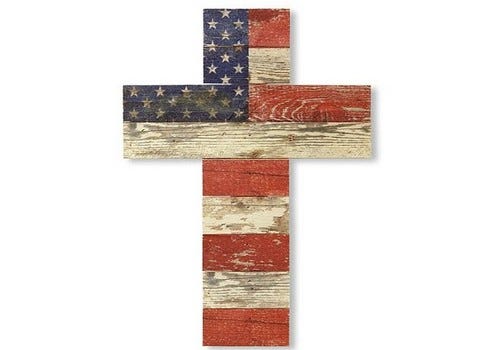
Praxis is all about action, writes Richard Pütz. When we look at the method called See-Judge-Act, we may have many members of the JOC movements who specialize in See/Observe and/or Judging/Discerning. But, there is a wing of the JOC movements that I will call the "Praxis Wing," those who are on the ground making things happen, organizing, and leading boots on the ground to bring about change, to bring about the kingdom of heaven here and now. The "Praxis Wing" picks up the last leg of the race and carries the Baton to bring about ACTION.
The alarming surge of Christian Nationalism in North America is an urgent issue that demands our immediate attention. Just as Fascism was a pressing concern during the time of Joseph Cardijn, we now face the rise of Christian Nationalism, which stands in stark contrast to the true essence of Christianity.
This is our moment to step up, speak out, and take action. We must educate our communities about the true biblical principles that Christian Nationalism does not represent. Our collective action can make a significant difference.
READ MORE
Are You Part of the Praxis Wing? - Part I (Cardijn Reflections)
Collaboration in the Public for the Public - Part II (Cardijn Reflections)
PHOTO
Jim Forest / Flickr / CC BY NC ND
News briefs and social media
Register here:
https://us02web.zoom.us/.../register/DibJyLjSSp6iXmW9biz3Iw
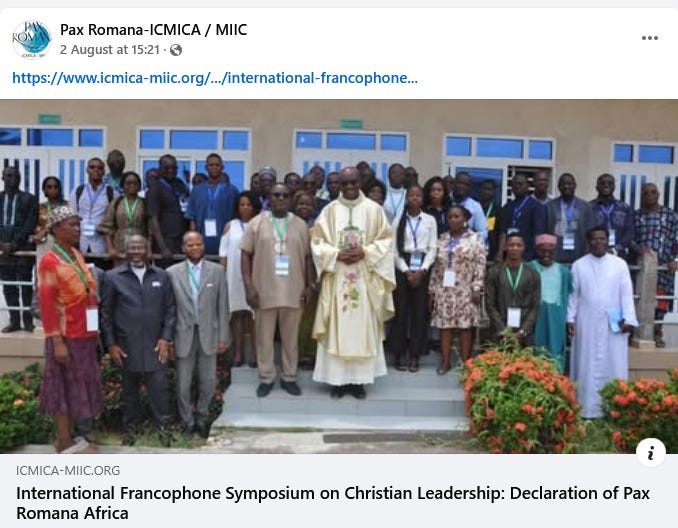
Read the declaration: https://www.icmica-miic.org/2025/08/international-francophone-symposium-on-christian-leadership-declaration-of-icmica-africa/
Editorial Note: The purpose of the Centre International Cardijn Newsletter is to share information and promote discussion. Citing or linking to articles does not imply any endorsement by the CIC of the authors' views
Join the Centre International Cardijn
Membership form here:
https://centreinternationalcardijn.org/join/
Thanks for reading Centre International Cardijn! Subscribe for free to receive new posts and support my work.