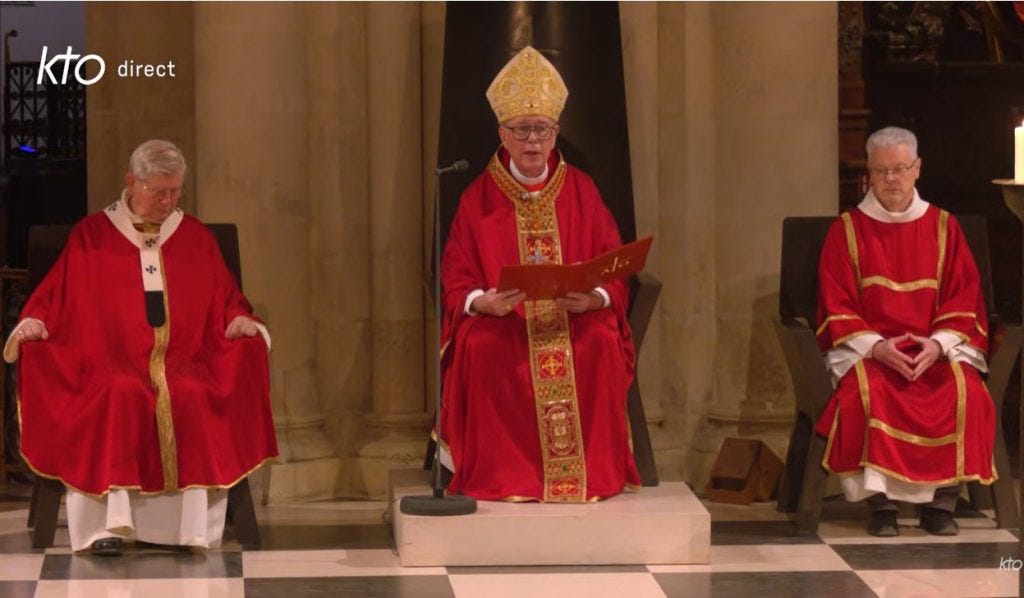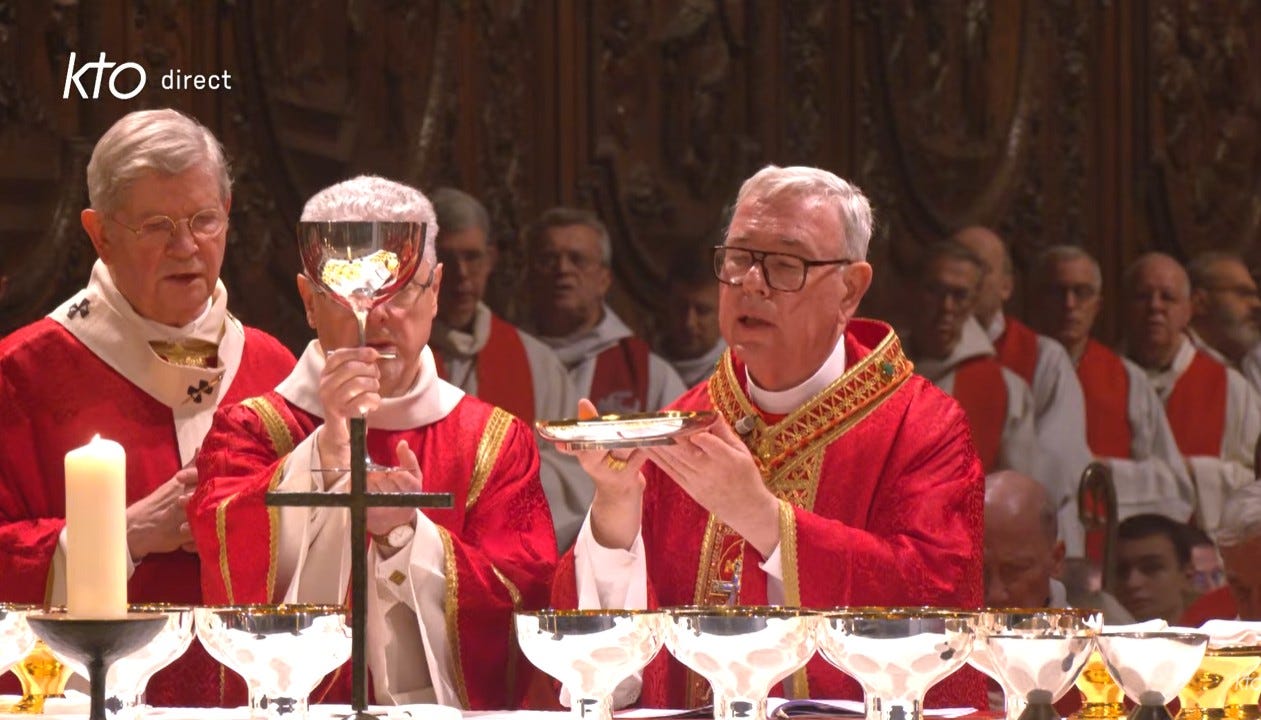
This is the homily of Cardinal Jean-Claude Hollerich, himself a former chaplain of the JEC and the JOC, at the beatification of the JOC martyrs, JEC members and scouts at Notre Dame Cathedral in Paris on Saturday, 13 December, 2025.
Dear colleagues,
Dear sisters,
Dear brothers,
The first half of the 20th century will go down in European history as the dark century of terrible carnage. To the soldiers of the two world wars were added the victims of the Nazi dictatorship. But within this darkness, there were points of light, and even now we can identify names and faces with some of these points of light. They had an immense love for God, for Christ. This love compelled them to serve their brothers who had been sent to Germany for forced labour. Indeed, there can be no love of God without love of neighbour.
A few weeks before the conclusion of our Jubilee Year, and on this eightieth anniversary of the end of the Second World War, as we prepare to celebrate Christmas, our Pope Leo XIV offers us the joy of celebrating the “birth into Heaven” of these fifty Martyrs of the Catholic Apostolate in Germany, who volunteered to assist their fellow workers requisitioned by the State.
These young Catholics—priests, religious, seminarians, Catholic Action activists, scouts—all responded to the call of Cardinal Suhard and Father Jean Rodhain. Most of them were between twenty and thirty-five years old, and understood, along with so many other anonymous apostles, the spiritual and moral distress of one million five hundred thousand young French workers deported to Germany, now without religious guidance, since German priests were forbidden to minister to them.
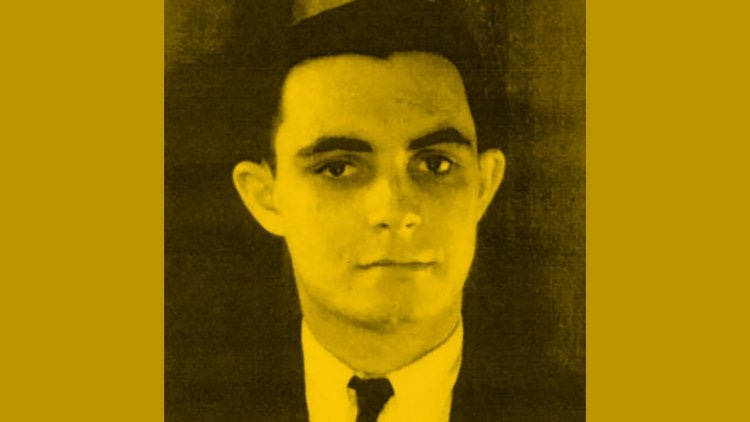
Without the slightest hesitation, Claude-Colbert Lebeau, a JOC leader, declared: “I did not come to work for Nazi Germany, but I came to bring my brothers and sisters the help of faith in Jesus Christ.” They were truly “Martyrs of the Apostolate.” Their lives and their work in service to their brothers and sisters were an ordeal crowned by the sacrifice of martyrdom, as the Book of Wisdom reminds us: “The souls of the righteous are in the hand of God. Like gold in the crucible, he has tested them; like a perfect offering, he accepts them.”
The Second Vatican Council teaches us this: “Martyrdom, in which the disciple is made like his master […] and made like him in the shedding of his blood, is regarded by the Church as an eminent grace and the supreme proof of charity. Although this is given only to a small number, all must nevertheless be ready to confess Christ before men and to follow him on the way of the cross, through the persecutions which never fail to befall the Church” (LG. 42).
By contemplating the testimony of love of these young men from some thirty dioceses, several institutes of consecrated life, Catholic Action, and scouting, by getting to know them, sharing their enthusiasm but also their fears, their bursts of generosity, and their sufferings, we realize how deeply they have lived these words of Saint Paul in their Letter to the Romans “We boast in the hope of sharing in the glory of God. Hope does not disappoint us, because God’s love has been poured into our hearts.”
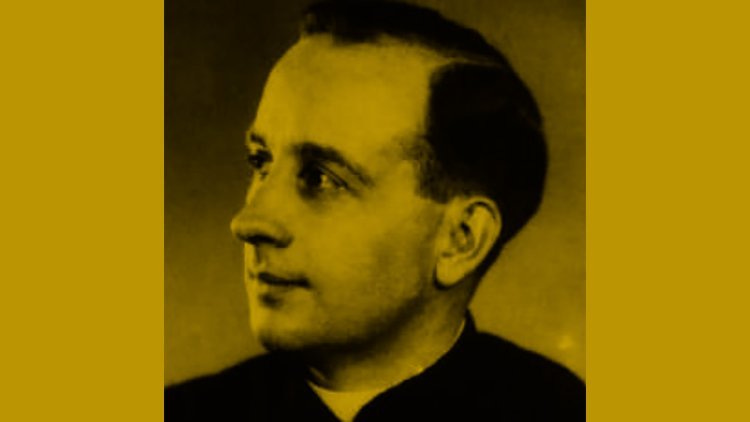
Father Pierre de Porcaro, a priest of the Diocese of Versailles, wrote to a seminarian: “I must become a saint. It is the only way to ensure a fruitful ministry later on. It is the only way to save souls. And since this is my desire, my only passion, I must become a saint.” Later, when his bishop invited him to join the young men conscripted for the STO (Service du Travail Obligatoire – Compulsory Work Service), he replied: “Yes, my God, I accept with all possible generosity, everything, including dying for it, dying in a foreign land, far from everything, far from everyone.”
All of them, without exception, made their lives, their work, their imprisonment, and their martyrdom a service—and what a service it was! They followed Jesus as true disciples, placing their steps in the footsteps of their Master. This call of Jesus, echoed in the Gospel of Saint John: “If anyone wants to serve me, he must follow me; and where I am, there will my servant be also. If anyone serves me, the Father will honor him,” they fulfilled in the sacrifice of their lives, in a generous offering. Thus, Father Antoine Charmet, a priest of the diocese of Lyon, now Saint-Étienne, wrote in his will: “I abandon myself to the will of God, asking Him to remain faithful to it as a priest.”
In the midst of the maelstrom of war and the inhuman atrocities of which we are now all too familiar, these Martyrs and all those who shared their ideals, their generosity, and their fate, demonstrated to their brothers and sisters the unwavering presence of God’s love and mercy. In this way, they succeeded in creating, within the hell of the camps, islands of paradise where love managed to restore courage, heal wounds of the heart, shake off indifference, and transmit serenity and peace. This was borne witness to the young scout Joël Anglès d’Auriac, beheaded at the age of twenty-two on 6 December, 1944, after having confessed, received communion, and prayed the rosary, when he declared to the prison chaplain: “I am completely at peace… for I am going to Jesus Christ.”
Our Martyrs carry a message that can never grow old: “Love will never pass away!” Young Jean Mestre gave up requesting exemption from the STO and announced it to his mother thus: “I love you with all my heart, but I love Jesus Christ even more than you, and I feel that he is calling me to be his witness to my comrades who are going to experience difficult times. Forgive me if I cause you pain.”
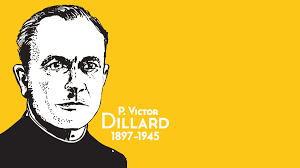
The celebration of this beatification, by placing these Blessed Ones before us, reminds us of the demands of our baptism: our faith in Christ is first and foremost, and essentially, a communion of love with his Person. In this sense, baptism commits us to nourish our lives and our many activities with this faith, this communion with Christ. The Jesuit Victor Dillard, the eldest of the Martyrs, an intellectual and apostle to young people, understood this well. He wrote at the time of his arrest: “I had long expected this arrest; it is natural. It happened to me on Good Shepherd Sunday, when it is said that the Good Shepherd must lay down his life for his sheep. It was perfectly timed. I would like this to make you understand how seriously our religion must be taken and how much it must be nurtured and lived ».
But to live it is to go all the way, as Raymond Cayré, a priest of the diocese of Albi, consumed by zeal, who died in Buchenwald, testifies: “There are souls here who need as much and even more than elsewhere the help of Heaven. The prospect of staying until the end does not frighten me and is familiar to me.”
This beatification invites us to look at the present and prepare for the future. In the aftermath of the Second World War, many Christians dedicated their lives to establishing peace and reconciliation, as evidenced by Robert Schuman, Alcide De Gasperi, Konrad Adenauer, and so many others, whose lives were devoted to serving the common good. For eighty years, we have been living through the longest period of peace that Western Europe has experienced in its long history, and yet we are not immune to war or violence.
Whatever our vocation, our profession, our responsibility, we are committed, as disciples of Christ, to the service of our brothers, wherever in His Providence, God has placed us.
Robert Schuman could write: “Christianity taught the equality of nature of all men, children of the same God, redeemed by the same Christ, without distinction of race, colour, class or profession. It established the dignity of work and the obligation for all to submit to it. It recognized the primacy of inner values which alone ennoble man. The universal law of love and charity made every man our neighbour, and social relations in the Christian world have since been based on it.”
We are living through, we have lived through, a reconciliation of peoples. It is a task that is never finished and that every generation must continue. And we are doing it together: you, French people, who can be proud of your martyrs, and peoples like the Luxembourgers, the Belgians, the Dutch, the Swiss, and the Germans, who are no longer enemies, but who work with us for the common good.
And that is why I am pleased that German bishops are also present today. Together we can build a Europe that does not exclude, does not persecute, and stands for peace and justice.
(That is why I am delighted by the presence of German bishops today. Together, we can build an inclusive Europe that persecutes no one and defends peace and justice.)
The Nazis, for their part, despised religious freedom. Forced to respect it in Germany, they revealed their true colors in the occupied territories. The love of our martyrs for Christ and for the people they rescued made them martyrs for religious freedom.
Perhaps this point will be an important witness for us regarding the future of the Church in Europe. Faith is never private; it must find expression in the concrete service of our sisters and brothers. But let me make an appeal to the young people of France. You who call yourselves young Catholics, you are devoted to the adoration of Our Lord, and that is as it should be: may this love of Christ impel you to become missionary apostles.
And all of you young people, perhaps not attending church, from France and Europe, you who no longer see meaning in your lives, you are searching for an identity that gives you purpose, look to Christ, Prince of Peace, Prince of love and not of hate, learn from Him as your elder brothers, martyrs, beatified today, learn from Him to commit yourselves to the good of your brothers and sisters! Your life can be so beautiful, and you will see this beauty in your life by following Christ.
Following the example of our Martyrs, let us strive to be faithful disciples of Christ, Prince of Peace, and let us ask those we celebrate today to obtain for us the grace to live our faith. Pope Francis always said that conversion begins in the head and passes into the heart, but that is not enough; it must also pass into the hands and feet. Let us ask for the grace to live our faith, and thus to work in service to his Kingdom. Amen!
Cardinal Jean-Claude Hollerich
SOURCE
Homily of Cardinal Jean-Claude Hollerich (Diocese of Paris)